Types Of Fouling In Heat Exchangers
What is fouling in Heat Exchangers?
Fouling is the accumulation
of unwanted material on the tube surfaces of the heat exchanger. After a period
of operation the heat transfer surface of heat exchanger may become coated with
various deposits presents in flow system. This coating represents an additional
resistance to heat flow and thus decreased in performance. Fouling factors are
best determined from experience with similar units in the same or similar
service. When such information is not available, recourse may be had to publish
data. The most comprehensive tabulation of fouling factors is the one developed
by TEMA, which is available in Refs. [1, 2]. Fouling can occur by a number of
mechanisms operating either alone or in combination. These include:
- Corrosion:
Corrosion products
such as rust can gradually build up on tube walls, resulting in reduced heat
transmission and eventual tube failure. This type of fouling can be minimized
or eliminated by the proper choice of corrosion-resistant materials of
construction in the design process.
- Crystallization:

- Decomposition:
Some organic
compounds may decompose when they are heated or come in contact with a hot
surface, forming carbonaceous deposits such as coke and tar. In cracking
furnaces, partial decomposition of the hydrocarbon feedstock is the objective
and coke formation is an undesired but unavoidable result.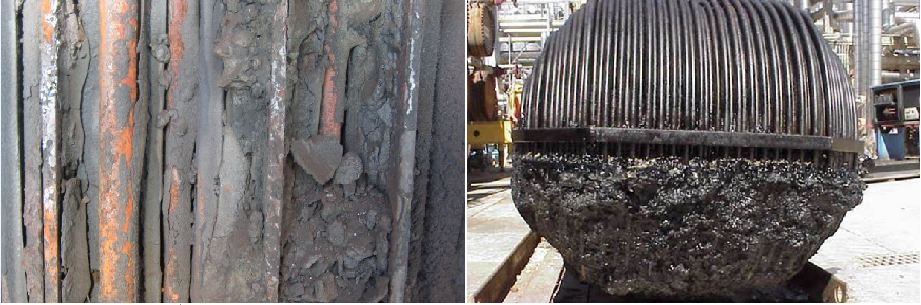
- Polymerization:

- Sedimentation:
Sedimentation fouling results from the
deposition of suspended solids entrained in many process streams such as
cooling water and flue gases. High fluid velocities tend to minimize the
accumulation of deposits on heat-transfer surfaces.

- Biological activity:
Biological fouling is
most commonly caused by micro-organisms, although macroscopic marine organisms
can sometimes cause problems as well. Cooling water and some other process
streams may contain algae or bacteria that can attach and grow on heat-transfer
surfaces, forming slimes that are very poor heat conductors. Metabolic products
of these organisms can also cause corrosion of metal surfaces. Biocides and
copper-nickel alloy tubing can be used to inhibit the growth of micro-organisms
and mitigate this type of fouling.

References:
- Kakac, S. and H. Lui, Heat Exchangers: Selection, Rating and Thermal Design, CRC Press Boca Raton FL, 1997.
- Standards of the Tubular Exchanger Manufacturers Association, 8th edn, Tubular Exchanger Manufacturers Assiociation, Inc, Tarrytown, NY, 1999.


I really like the heater project. It gives me ideas beyond my imaginations. Heating and Cooling Oakville
ReplyDeleteThis is a nice post. It has a good tips here. Thank you for sharing. For more information visit here https://aicheatexchangers.com/
ReplyDelete
ReplyDeleteNice article. Thanks for sharing this nice information for me. I hope you will share some more information.We also offer heat exchanger .
Nice blog. Thanks for sharing a nice blog. It’s very interesting and useful for me....please visit my website I assure you that it will benefit you." air to air heat exchanger"
ReplyDeleteAir cooled heat exchangers are used to transfer heat from a process fluid to ambient air. The process fluid is contained within heat conducting tubes.
ReplyDeleteI really enjoyed this post. You describe this topic very well. I really enjoy reading your blog and I will definitely bookmark it! Keep up the interesting posts! Thanks for sharing informative blog. Visit here: “ Heat Exchanger Manufacturers”
ReplyDeleteHere we come up with new machinery plant named Alaquainc, which specializes in designing and manufacturing a broad range of different crystallizer systems designs to fulfill diverse client requirements. To learn more about Alaqua Inc please visit on the website www.alaquainc.com
ReplyDeleteThanks for sharing very informative data about types of fouling in heat exchangers.
ReplyDeletecan you please note and share the best Shell and tube oil cooler manufacturersand share it.
ReplyDeleteAlaquainc, which specializes in designing and manufacturing a broad range of different crystallizer systems designs to fulfill diverse client requirements.
ReplyDeleteThanks For Shareing This you blog is Really very nice in this blog I relly like this topic.made in usa distillation equipment A cracked heat exchanger should never be attempted to be inspected and/or repaired by the homeowner. and should instead be replaced. Request an inspection and diagnosis from a trained technician. An expert can tell you on the best option and how to maintain your heating system.
ReplyDeleteNice articles and your information valuable and good articles thank for the sharing information Industrial heat exchangers
ReplyDeleteSwastik Hydraulic is a leading manufacturer of high-quality shell and tube heat exchangers. We are trusted Shell and Tube Heat Exchanger Manufacturers in New Delhi, known for our precision and performance. Our expertise also extends as reliable Shell and Tube Heat Exchanger Manufacturers in Noida and Shell and Tube Heat Exchanger Manufacturers in Ahmedabad, serving various industries with efficient thermal solutions.
ReplyDeleteI simply loved this post. You describe this topics very well. I without a doubt enjoy analyzing your blog and I will really bookmark it! Keep up the interesting posts! Thanks for sharing informative blog. Anpam Engineering is a leading manufacturer of heat exchangers in India, considered for its high quality goods and innovative technology. Visit here: Heat Exchanger Manufacturer , Heat exchanger design
ReplyDeleteThanks for sharing such an informative post! I was recently looking into different cooling systems for industrial equipment, and I found that aircooledoilcoolers offer excellent efficiency, lower maintenance needs, and improved equipment performance. Your explanation made the concept much clearer and highlighted their real-world benefits. Looking forward to reading more of your insightful articles.
ReplyDeleteThank you for the helpful blog, "Types Of Fouling In Heat Exchangers." I want you to know that your information is invaluable for aspiring candidates. Keep sharing valuable updates!
ReplyDeleteChandu Biology Classes
Keep your critical process equipment operating at peak performance with Industrial Machinery Est., a trusted provider of professional heat exchanger services in Saudi Arabia. From inspection and chemical cleaning to repair, re-tubing, refurbishment, and complete overhauls, our experienced team delivers tailored maintenance solutions that restore thermal efficiency, minimize unplanned downtime, and extend equipment life. Whether during routine maintenance or major plant turnarounds, Industrial Machinery Est. helps refineries, petrochemical facilities, power plants, and industrial operations maximize reliability, safety, and productivity.
ReplyDeleteThis is an excellent and well-researched article. I really appreciate how you've explained the importance of maintaining hydraulic systems in a practical and easy-to-understand way. Many people focus on the major components like pumps and cylinders, but proper heat management is just as important for ensuring long-term performance and reliability.
ReplyDeleteIn industrial environments, excessive heat can lead to reduced oil viscosity, increased component wear, and unexpected equipment failures. That's why choosing the right cooling solution and following a regular maintenance schedule can make a significant difference in operational efficiency. Preventive maintenance not only extends equipment life but also helps reduce downtime and overall maintenance costs.
I also believe that every application has unique operating conditions, so selecting the right oil cooler should never be a one-size-fits-all decision. Factors such as oil flow rate, operating pressure, ambient temperature, and cooling capacity all play an important role in achieving the best performance. Working with an experienced hydraulic oil cooler manufacturer can help industries choose a solution that matches their specific requirements and improves overall system efficiency.
Thank you for sharing such valuable insights with the engineering and industrial community. Content like this helps maintenance professionals, engineers, and business owners better understand the importance of effective thermal management in hydraulic systems. I look forward to reading more informative articles covering hydraulic technology, industrial cooling solutions, energy efficiency, and maintenance best practices. Keep up the great work, and thanks again for contributing such useful knowledge to the industry.
Fantastic article! I found the information both informative and relevant to today's industrial challenges. Many businesses are searching for ways to increase equipment efficiency while lowering maintenance costs, and your article provides valuable guidance toward achieving those goals. Selecting a professional
ReplyDeleteHydraulic Oil Cooler Manufacturer is an important part of maintaining reliable hydraulic systems, especially in demanding applications. I appreciate your balanced approach and the practical advice you included throughout the post. Thank you for sharing such valuable knowledge with your readers. Looking forward to your next article.
Whether you need cooling solutions for agriculture, CNC machines, concrete pumps, or material handling equipment, CoolACE has the right products. The Air Cooled Oil Cooler provides effective temperature control, enhances productivity, and ensures reliable operation even in demanding environments.
ReplyDeleteSpot-on article regarding the importance of effective heat exchangers! Thermal stress is often the silent killer of heavy industrial machinery and hydraulic fluid systems. Partnering with leading oil cooler manufacturers in india
ReplyDeleteenables companies to obtain tailored cooling units designed specifically for extreme ambient temperature conditions. High-efficiency thermal systems are absolutely crucial for maintaining fluid viscosity, reducing oil degradation, and keeping overall equipment maintenance budgets under check. Quick question—what routine testing method do you personally recommend for detecting early internal core leaks before major failure occurs? Thanks for publishing such a practical piece!"
Maintaining the right oil temperature is essential for the smooth operation of industrial equipment. Excessive heat can reduce lubrication efficiency, increase wear, and lead to unexpected equipment failure.Oil cooler heat exchangers are designed to remove excess heat from the oil, ensuring stable performance and reliable operation in demanding environments. They help extend oil life, improve energy efficiency, reduce maintenance costs, and protect critical machine components. Widely used in hydraulic systems, compressors, generators, and heavy machinery, these cooling solutions enhance overall productivity. Investing in high-quality Oil cooler heat exchangers is a smart decision for businesses looking to maximize equipment lifespan, minimize downtime, and achieve long-term operational efficiency.
ReplyDeleteAir Cooled Heat Exchanger** plays a vital role in improving industrial cooling efficiency while reducing water consumption. It is widely used in industries such as power generation, oil & gas, petrochemicals, and manufacturing because of its reliable performance and low maintenance requirements. An Air Cooled Heat Exchanger transfers heat using ambient air instead of water, making it an environmentally friendly and cost-effective solution. With advancements in design and materials, modern systems offer better thermal performance, longer service life, and improved energy efficiency. Choosing the right heat exchanger based on operating conditions can significantly enhance productivity and reduce operating costs. Regular inspection and maintenance also help ensure consistent performance and prevent unexpected downtime, making it a dependable investment for industrial cooling applications.
ReplyDeleteaircooledoilcoolers
ReplyDeleteis a simple, highly reliable component that effectively lowers engine or transmission fluid temperatures by transferring heat directly from external fins into passing ambient air. Because it operates independently of the vehicle's liquid cooling system, it completely eliminates the risk of oil-coolant cross-contamination, making it a popular choice for track cars, heavy-duty towing rigs, and naturally air-cooled engines. However, its performance relies heavily on vehicle movement to maintain airflow, meaning cooling efficiency drops significantly at low speeds or during extended idling unless paired with an electric fan.
A hydraulic oil cooler is essential for maintaining the proper temperature of hydraulic systems. It helps reduce excess heat, protects components from wear, and improves overall machine efficiency. Choosing a reliable hydraulic oil cooler
ReplyDeleteaccording to oil flow, pressure, and operating conditions can ensure better performance and extend equipment life.
The ACE AH Series is engineered to deliver dependable cooling performance for industrial hydraulic and lubrication systems. These air cooled heat exchangers are suitable for gearbox cooling, hydraulic return line cooling, and offline cooling applications. With efficient heat transfer capabilities, the Plate heat Exchanger solution can help industries achieve better temperature control and system reliability. ACE combines durable construction, efficient airflow, and industrial-grade performance in its cooling systems.
ReplyDeleteThis comment has been removed by the author.
ReplyDeleteThis comment has been removed by the author.
ReplyDeleteThis is a very informative discussion for anyone involved in hydraulic machinery and industrial equipment. One aspect that often gets overlooked is the importance of controlling operating temperature during continuous machine operation. Hydraulic equipment can generate considerable heat because of fluid friction, pressure losses, pumps, valves, and other components working under demanding conditions. If that heat is not managed properly, it can affect oil viscosity, component performance, sealing materials, and the overall efficiency of the hydraulic circuit.
ReplyDeleteA properly selected Hydraulic cooling system can play an important role in maintaining the oil within an appropriate operating temperature range. This becomes particularly valuable in applications where machinery operates for long hours or under high-load conditions. Depending on the application, factors such as ambient temperature, hydraulic oil flow, system pressure, available installation space, and heat generation should all be considered before selecting a cooling solution.
Another important point is regular maintenance. Even a well-designed cooling arrangement may not perform efficiently if the heat exchanger becomes dirty, airflow is restricted, or the hydraulic fluid is not maintained correctly. Periodic inspection can help identify problems before they turn into expensive equipment failures.
I also appreciate that the article focuses on practical considerations instead of discussing cooling only from a theoretical perspective. In real industrial environments, reliability, energy consumption, maintenance requirements, and operating conditions all influence the choice of cooling equipment.
Overall, temperature management should be treated as an essential part of hydraulic system design rather than an optional addition. Anyone responsible for hydraulic machinery should evaluate heat generation and cooling requirements early in the design process. This can contribute to more stable operation, improved component life, and better overall machine performance.
Energy efficiency is an important consideration when designing modern thermal systems, and can contribute to efficient energy transfer. The plate configuration provides a large heat-transfer surface relative to the physical size of the equipment. a Brazed Plate Heat Exchanger
ReplyDeleteThis allows heat to move effectively between separate fluid streams while keeping the overall exchanger compact. In applications such as heat recovery, heating water, cooling process fluids, and HVAC systems, recovering or transferring available thermal energy can reduce unnecessary energy losses. However, exchanger efficiency depends on more than the equipment itself. Correct sizing, flow distribution, temperature differences, fluid properties, and pressure-drop requirements all influence the actual performance of the system. If an exchanger is incorrectly selected, the system may experience inadequate heat transfer or excessive pumping requirements. For this reason, engineers should evaluate the complete operating envelope before specifying a Brazed Plate Heat Exchanger. When correctly matched to the application, it can support efficient thermal management and help systems make better use of available energy. This makes plate heat-exchanger technology an important consideration for facilities looking to improve overall heating and cooling performance.
Hydraulic machinery often operates under heavy loads and continuous working conditions, making effective oil cooling an important part of system performance. A reliable cooling solution should provide efficient heat dissipation while maintaining durability and consistent operation. The hydraulic oil cooler is designed to help remove excess heat from hydraulic oil and maintain stable operating temperatures. Its efficient heat transfer performance can support smoother hydraulic operation and help reduce the effects of excessive heat on system components. With a compact structure and dependable construction, it can be suitable for industrial equipment, mobile machinery, and other hydraulic applications requiring reliable oil temperature management.
ReplyDeleteI found the explanation quite useful because proper temperature management is essential for hydraulic equipment, especially when a hydraulic cooling system
ReplyDeleteis operating under heavy loads.
Great information for hydraulic equipment users. Understanding how a hydraulic cooling system works can help businesses make better decisions about equipment maintenance and performance.
ReplyDeleteI appreciate the practical information shared in this article. Proper maintenance becomes especially important when a hydraulic cooling system
ReplyDeleteis used in demanding industrial environments.
Standard off-the-shelf thermal hardware rarely meets the precise pressure drop and heat load criteria of specialized production plants. Working directly with top-tier Air Cooled Heat Exchanger Manufacturers in India gives plant engineers direct access to advanced thermal simulation software and custom mechanical engineering. Whether retrofitting an existing congested footprint or designing a Greenfield setup, Indian manufacturers deliver tailored header configurations, modular tube bundles, and automated variable-frequency fan controls that integrate seamlessly into complex industrial fluid circuits.
ReplyDeleteIf you are looking for an effective cooling solution, awater oil cooleris worth considering for suitable industrial applications. Proper heat management can help improve equipment performance.
ReplyDeleteThis article provides a useful overview of an often-overlooked part of hydraulic system design. When machinery runs continuously, controlling the temperature of hydraulic fluid becomes increasingly important. A Water Cooled Hydraulic Cooler
ReplyDeletecan help manage thermal buildup by using water to carry heat away from the hydraulic circuit. However, the right equipment should be selected after considering the application's heat load and operating conditions. Regular maintenance is also important because buildup or restricted flow can affect heat transfer. I like that this topic is explained from a practical perspective. It can be useful for engineers, technicians, and businesses maintaining hydraulic machinery.
Premium-quality Oil Cooler heat exchangers engineered for efficient temperature control in demanding industries. Our Air Cooled Oil Cooler range delivers reliable performance, durable construction & easy maintenance. Contact us for product details and pricing.
ReplyDeleteKeep hydraulic oil within an ideal operating range using a dependable cooling solution for industrial applications. The Air Cooled Oil Coolercooler delivers effective heat dissipation and reliable performance for machinery working under demanding temperature conditions.
ReplyDeleteWith a focus on efficient heat dissipation, Ace manufactures quality Air Cooled Oil Cooler equipment, also known as Air Oil Cooler, Fan Cooled Oil Cooler, Air Blast Oil Cooler, or Finned Tube Heat Exchanger.
ReplyDeleteAce is committed to supplying reliable thermal management solutions for industrial applications where efficient oil cooling is essential. Our products are designed to help remove heat generated during continuous machine operation and maintain oil within a suitable working temperature range. The Oil Cooler Heat Exchanger is an important solution for applications requiring dependable heat dissipation without relying on a separate water-cooling circuit. Ace offers different configurations and cooling options to suit hydraulic machinery, power packs, CNC equipment, compressors, and industrial systems.
ReplyDeleteContinuous industrial operations place considerable demands on machinery. When equipment runs for extended periods, heat generation can become a major concern. Maintaining an appropriate oil temperature is particularly important in hydraulic and lubrication systems because fluid temperature can influence viscosity, component protection, and overall system performance.
ReplyDeleteChoosing the right cooling equipment requires a detailed understanding of the application. Heat generation, oil circulation, operating pressure, environmental conditions, cooling-medium availability, and required temperature range should all be evaluated. A cooling system that is undersized may not remove sufficient heat, while an unnecessarily large system may increase installation and operating costs.
An Oil cooler Heat Exchanger
can help address these requirements by enabling heat to move from the hot oil into a suitable cooling medium. When properly designed and matched to the application, this type of solution can support more stable thermal conditions in demanding industrial environments.
However, equipment selection is only one part of effective thermal management. Installation quality and maintenance are equally important. Connections should be inspected regularly, heat-transfer surfaces should be kept clean, and operating temperatures should be monitored. Any unusual increase in temperature should be investigated rather than ignored.
This discussion is useful because it demonstrates how cooling efficiency can influence overall machinery reliability. Maintaining stable temperatures can help reduce thermal stress and support predictable machine operation.
Overall, industries looking to improve the reliability of hydraulic or oil-based equipment should consider thermal management as an integral part of their maintenance and engineering strategy. Proper cooling selection combined with preventive maintenance can make a meaningful contribution to efficient and dependable industrial operations.
Reliability is a major priority for industries that depend on hydraulic and mechanical equipment for daily production. Unexpected overheating can interrupt operations, increase maintenance costs, and potentially shorten the service life of important components. Effective cooling therefore deserves the same attention as other critical aspects of machinery design.
ReplyDeleteA suitable Air Cooled Oil Cooler can help manage the heat generated during continuous hydraulic operation. The basic working principle is straightforward: hot oil passes through a heat-transfer core while a fan forces ambient air across the cooling surfaces. Heat is transferred away from the oil, helping maintain a more controlled operating temperature.
Of course, the effectiveness of a cooling system depends on proper engineering. Cooler capacity should correspond to the system's actual heat load and oil flow requirements. Ambient temperature is another important factor because cooling performance can change significantly in hot operating environments. Installation location, airflow clearance, and cleanliness of the heat exchanger should also be considered.
Another useful point is the relationship between cooling and preventive maintenance. Operators can monitor oil temperature and look for unusual changes in performance that may indicate blocked airflow, fan problems, contamination, or other system issues. Addressing these concerns early can prevent larger failures.
This is a relevant topic for engineers, maintenance teams, and industrial equipment users. Good thermal management is not simply about reducing temperature; it is about maintaining suitable operating conditions consistently. Articles that explain this relationship in practical terms are helpful for readers looking to improve machinery reliability and long-term performance.
Overheating is a common concern in machinery that operates under demanding conditions. Hydraulic pumps, motors, valves, gear systems, and other components can generate significant amounts of heat during operation. If this heat accumulates faster than it can be removed, oil temperature may increase beyond the desired operating range. Addressing the issue early can help prevent avoidable performance and maintenance problems.
ReplyDeleteOne practical component used for thermal control is an oil cooler Heat Exchanger. It provides a heat-transfer path between the circulating oil and a cooling medium, allowing excess heat to be removed from the system. The effectiveness of the solution depends on the exchanger design, operating conditions, and available cooling capacity.
It is important to understand that an overheating problem should not automatically be attributed to insufficient cooler size. Restricted oil flow, excessive system pressure, incorrect fluid viscosity, contaminated heat-transfer surfaces, or inadequate cooling-medium flow can also contribute to higher temperatures. A complete system assessment is therefore recommended when troubleshooting.
Preventive maintenance can make a significant difference. Checking connections for leakage, monitoring oil temperature, inspecting heat-transfer surfaces, and maintaining proper fluid conditions can help identify potential issues before they become serious. Maintenance schedules should be adapted to the machinery's workload and operating environment.
I found this topic useful because it emphasizes a systematic approach to temperature management. Industrial cooling is not just about installing equipment; it involves correct design, monitoring, and maintenance. When these elements work together, machinery can operate more consistently and organizations can reduce the risk of unnecessary downtime.
Ace is a trusted manufacturer of industrial oil cooling equipment, offering practical solutions for various applications. Our Air Cooled Oil Cooler systems provide efficient heat dissipation and reliable performance in demanding working conditions.
ReplyDelete