Posts

Showing posts with the label process design

Common Cooling Tower Problems – Interference, Recirculation and Legioellosis

Image
Interference and Recirculation: A number of cooling towers may have to be used if the hot water load is large. The tower are very often installed at one place in the plant for convenience. Interference and recirculation are two common problems with cooling towers placed in proximity. Some of the moist air leaving a tower may be sucked into another tower installed “downwind” in the vicinity of the former [Figure 1(a)] affecting the performance. This is called “ interference ” . Sometimes a part of the moist air from a tower may be sucked into itself by the “forced-draft fan”. This is “recirculation” [Figure 1(b)]. The ratio of the “plume velocity” to the “wind velocity” is an important factor to determine the extent of recirculation. If this ratio is small, a forced-draft tower becomes more susceptible to recirculation [Figure 1(c)]. Both the phenomena of interference and recirculation reduce the enthalpy driving for cooling and adversely affect the performance of cooling towe...

Design Calculation (Sizing) Of A Crystallizer

Image
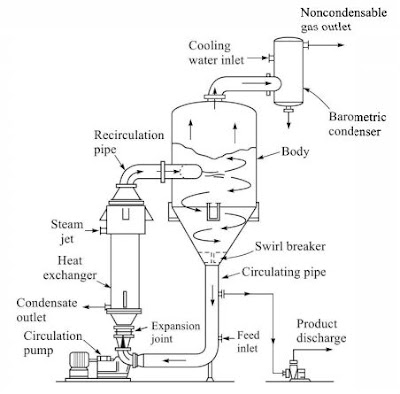
Problem Statement And Given Data: Given the following data and information, it is required to design a forced circulation crystallizer of the type shown in Figure 1 operating under vacuum. Figure 1 Forced circulation (FC) evaporation crystallizer.   Feed (an aqueous solution) rate, Qi = 15 m 3 /h, feed concentration, Ci = 200 kg/m 3 solution; feed temperature = 55 o C; average density of the solution = 1100 kg/m 3 and average specific heat = 0.90 kcal/kg. o C; operating pressure = 100 mm Hg (660 mm Hg vacuum); boiling point elevation of the saturated solution = 13 o C; saturation concentration at the crystallization temperature = 250 kg/m 3 ; magma density allowed, M T = 350 kg crystal/m 3 solution; crystal growth rate determined experimentally under the conditions of the crystallizer, G = 4.67 x 10 -8 m/s; crystal density = 1700 kg/m 3 ; desired dominant crystal size L D = 0.8 mm; heat of vaporization of water at the temperature of the crystallizer = 570 kca...

Crystallizer Design Considerations

Image
Crystallizer Design Considerations: Figure 1. Forced circulation evaporative crystallizer . The function of a crystallizer is to produce crystals of a given size specification from a feed are a specific rate. A suitable and adequate supersaturation is created by cooling the feed or by partial evaporation of the solvent. The second method is more common in industrial practice. It has been mentioned before that a narrow particle size distribution of the product is desired to maintain a good product quality. Besides the correct supersaturation and environment (i.e. agitation, pumping rate etc.), techniques like redissolution or classified product removal are helpful to achieve a better product quality. Bath crystallizers require seeding (i.e. addition of fine crystals that act as nuclei). Secondly, nucleation occurs continuously in a continuous crystallizer and seeding is not generally necessary.  The more important parameters and quantities involved in the design ...