Posts

Showing posts with the label design

Cooling Tower Design Calculations - Height of Packing & Air Flow Rate

Image
Problem Statement & Given Data: Warm water at 45°C is to be cooled to 30°C by countercurrent contact with air in a tower packed with wood slats . The inlet air has a dry-bulb temperature of 31°C and a wet-bulb temperature of 22°C. The mass flow rate of water is 6000 kg/m 2 .h and that of air is 1.4 times the minimum. The individual gas-phase mass transfer coefficient is k Y’ a = 6000 kg/m 3 .h.∆Y’. The volumetric water-side heat transfer coefficient is given by h L a = 0.059 x L 0.51 x G S , in kcal/m 3 .h.K, where L and G S are mass low rates of water and air (dry basis). Determine (a) the dry air flow rate to be used, (b) the height of packing. Solution: (a)                                                Inlet air: T G = 31°C; T W = 22°C = T as                            ...

Sizing Of A Rotary Dryer

Image
        Rotary dryers , called the “workhorse of chemical dryers” , belong to the most widely used class of continuous dryers in process industries. These dryers are suitable for relatively free-flowing, non-sticky and granular materials; for example, almost all types of crystals after crystallization and washing. Typical applications of rotary dryers are in drying o table salt, sodium sulphate, ammonium sulphate, and many other salts, drying of sand, minerals, organic solids, polymer resin beads , to mention a few. A rotary dryer consists of a slowly rotating slightly inclined cylindrical shell fed with the moist solid at the upper end. The material flows along the rotating shell, gets dried and leaves the dryer at the lower end.          It is difficult, if not impossible, to design a rotary dryer on the basis of fundamental principles only. The available design correlations are a few in number and may not prove to be satisfact...

Crystallizer Design Considerations

Image
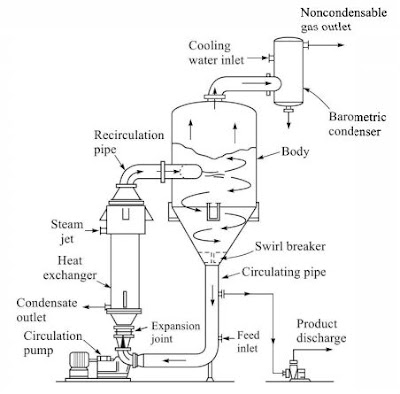
Crystallizer Design Considerations: Figure 1. Forced circulation evaporative crystallizer . The function of a crystallizer is to produce crystals of a given size specification from a feed are a specific rate. A suitable and adequate supersaturation is created by cooling the feed or by partial evaporation of the solvent. The second method is more common in industrial practice. It has been mentioned before that a narrow particle size distribution of the product is desired to maintain a good product quality. Besides the correct supersaturation and environment (i.e. agitation, pumping rate etc.), techniques like redissolution or classified product removal are helpful to achieve a better product quality. Bath crystallizers require seeding (i.e. addition of fine crystals that act as nuclei). Secondly, nucleation occurs continuously in a continuous crystallizer and seeding is not generally necessary.  The more important parameters and quantities involved in the design ...