Types Of Fouling In Heat Exchangers
What is fouling in Heat Exchangers?
Fouling is the accumulation
of unwanted material on the tube surfaces of the heat exchanger. After a period
of operation the heat transfer surface of heat exchanger may become coated with
various deposits presents in flow system. This coating represents an additional
resistance to heat flow and thus decreased in performance. Fouling factors are
best determined from experience with similar units in the same or similar
service. When such information is not available, recourse may be had to publish
data. The most comprehensive tabulation of fouling factors is the one developed
by TEMA, which is available in Refs. [1, 2]. Fouling can occur by a number of
mechanisms operating either alone or in combination. These include:
- Corrosion:
Corrosion products
such as rust can gradually build up on tube walls, resulting in reduced heat
transmission and eventual tube failure. This type of fouling can be minimized
or eliminated by the proper choice of corrosion-resistant materials of
construction in the design process.
- Crystallization:

- Decomposition:
Some organic
compounds may decompose when they are heated or come in contact with a hot
surface, forming carbonaceous deposits such as coke and tar. In cracking
furnaces, partial decomposition of the hydrocarbon feedstock is the objective
and coke formation is an undesired but unavoidable result.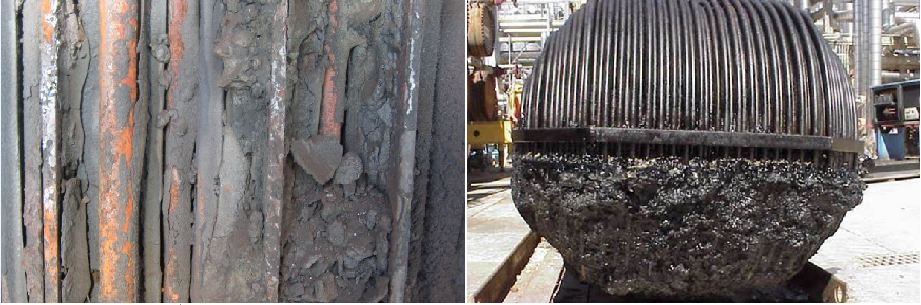
- Polymerization:

- Sedimentation:
Sedimentation fouling results from the
deposition of suspended solids entrained in many process streams such as
cooling water and flue gases. High fluid velocities tend to minimize the
accumulation of deposits on heat-transfer surfaces.

- Biological activity:
Biological fouling is
most commonly caused by micro-organisms, although macroscopic marine organisms
can sometimes cause problems as well. Cooling water and some other process
streams may contain algae or bacteria that can attach and grow on heat-transfer
surfaces, forming slimes that are very poor heat conductors. Metabolic products
of these organisms can also cause corrosion of metal surfaces. Biocides and
copper-nickel alloy tubing can be used to inhibit the growth of micro-organisms
and mitigate this type of fouling.

References:
- Kakac, S. and H. Lui, Heat Exchangers: Selection, Rating and Thermal Design, CRC Press Boca Raton FL, 1997.
- Standards of the Tubular Exchanger Manufacturers Association, 8th edn, Tubular Exchanger Manufacturers Assiociation, Inc, Tarrytown, NY, 1999.


I really like the heater project. It gives me ideas beyond my imaginations. Heating and Cooling Oakville
ReplyDeleteThis is a nice post. It has a good tips here. Thank you for sharing. For more information visit here https://aicheatexchangers.com/
ReplyDelete
ReplyDeleteNice article. Thanks for sharing this nice information for me. I hope you will share some more information.We also offer heat exchanger .
Nice blog. Thanks for sharing a nice blog. It’s very interesting and useful for me....please visit my website I assure you that it will benefit you." air to air heat exchanger"
ReplyDeleteAir cooled heat exchangers are used to transfer heat from a process fluid to ambient air. The process fluid is contained within heat conducting tubes.
ReplyDeleteI really enjoyed this post. You describe this topic very well. I really enjoy reading your blog and I will definitely bookmark it! Keep up the interesting posts! Thanks for sharing informative blog. Visit here: “ Heat Exchanger Manufacturers”
ReplyDeleteHere we come up with new machinery plant named Alaquainc, which specializes in designing and manufacturing a broad range of different crystallizer systems designs to fulfill diverse client requirements. To learn more about Alaqua Inc please visit on the website www.alaquainc.com
ReplyDeleteThanks for sharing very informative data about types of fouling in heat exchangers.
ReplyDeletecan you please note and share the best Shell and tube oil cooler manufacturersand share it.
ReplyDeleteAlaquainc, which specializes in designing and manufacturing a broad range of different crystallizer systems designs to fulfill diverse client requirements.
ReplyDeleteThanks For Shareing This you blog is Really very nice in this blog I relly like this topic.made in usa distillation equipment A cracked heat exchanger should never be attempted to be inspected and/or repaired by the homeowner. and should instead be replaced. Request an inspection and diagnosis from a trained technician. An expert can tell you on the best option and how to maintain your heating system.
ReplyDeleteNice articles and your information valuable and good articles thank for the sharing information Industrial heat exchangers
ReplyDeleteSwastik Hydraulic is a leading manufacturer of high-quality shell and tube heat exchangers. We are trusted Shell and Tube Heat Exchanger Manufacturers in New Delhi, known for our precision and performance. Our expertise also extends as reliable Shell and Tube Heat Exchanger Manufacturers in Noida and Shell and Tube Heat Exchanger Manufacturers in Ahmedabad, serving various industries with efficient thermal solutions.
ReplyDeleteI simply loved this post. You describe this topics very well. I without a doubt enjoy analyzing your blog and I will really bookmark it! Keep up the interesting posts! Thanks for sharing informative blog. Anpam Engineering is a leading manufacturer of heat exchangers in India, considered for its high quality goods and innovative technology. Visit here: Heat Exchanger Manufacturer , Heat exchanger design
ReplyDeleteThanks for sharing such an informative post! I was recently looking into different cooling systems for industrial equipment, and I found that aircooledoilcoolers offer excellent efficiency, lower maintenance needs, and improved equipment performance. Your explanation made the concept much clearer and highlighted their real-world benefits. Looking forward to reading more of your insightful articles.
ReplyDeleteThank you for the helpful blog, "Types Of Fouling In Heat Exchangers." I want you to know that your information is invaluable for aspiring candidates. Keep sharing valuable updates!
ReplyDeleteChandu Biology Classes
Keep your critical process equipment operating at peak performance with Industrial Machinery Est., a trusted provider of professional heat exchanger services in Saudi Arabia. From inspection and chemical cleaning to repair, re-tubing, refurbishment, and complete overhauls, our experienced team delivers tailored maintenance solutions that restore thermal efficiency, minimize unplanned downtime, and extend equipment life. Whether during routine maintenance or major plant turnarounds, Industrial Machinery Est. helps refineries, petrochemical facilities, power plants, and industrial operations maximize reliability, safety, and productivity.
ReplyDeleteThis is an excellent and well-researched article. I really appreciate how you've explained the importance of maintaining hydraulic systems in a practical and easy-to-understand way. Many people focus on the major components like pumps and cylinders, but proper heat management is just as important for ensuring long-term performance and reliability.
ReplyDeleteIn industrial environments, excessive heat can lead to reduced oil viscosity, increased component wear, and unexpected equipment failures. That's why choosing the right cooling solution and following a regular maintenance schedule can make a significant difference in operational efficiency. Preventive maintenance not only extends equipment life but also helps reduce downtime and overall maintenance costs.
I also believe that every application has unique operating conditions, so selecting the right oil cooler should never be a one-size-fits-all decision. Factors such as oil flow rate, operating pressure, ambient temperature, and cooling capacity all play an important role in achieving the best performance. Working with an experienced hydraulic oil cooler manufacturer can help industries choose a solution that matches their specific requirements and improves overall system efficiency.
Thank you for sharing such valuable insights with the engineering and industrial community. Content like this helps maintenance professionals, engineers, and business owners better understand the importance of effective thermal management in hydraulic systems. I look forward to reading more informative articles covering hydraulic technology, industrial cooling solutions, energy efficiency, and maintenance best practices. Keep up the great work, and thanks again for contributing such useful knowledge to the industry.
Fantastic article! I found the information both informative and relevant to today's industrial challenges. Many businesses are searching for ways to increase equipment efficiency while lowering maintenance costs, and your article provides valuable guidance toward achieving those goals. Selecting a professional
ReplyDeleteHydraulic Oil Cooler Manufacturer is an important part of maintaining reliable hydraulic systems, especially in demanding applications. I appreciate your balanced approach and the practical advice you included throughout the post. Thank you for sharing such valuable knowledge with your readers. Looking forward to your next article.
Whether you need cooling solutions for agriculture, CNC machines, concrete pumps, or material handling equipment, CoolACE has the right products. The Air Cooled Oil Cooler provides effective temperature control, enhances productivity, and ensures reliable operation even in demanding environments.
ReplyDelete